
Aquarium Size, Water Weight & Fish Stocking: The Safe Tank Guide
Calculate actual aquarium water volume, structural floor load weight (1.0 kg/L / 8.34 lbs/gal), and safe fish stocking limits. Move beyond the flawed 1-inch-per-gallon myth.
Key Technical Takeaways
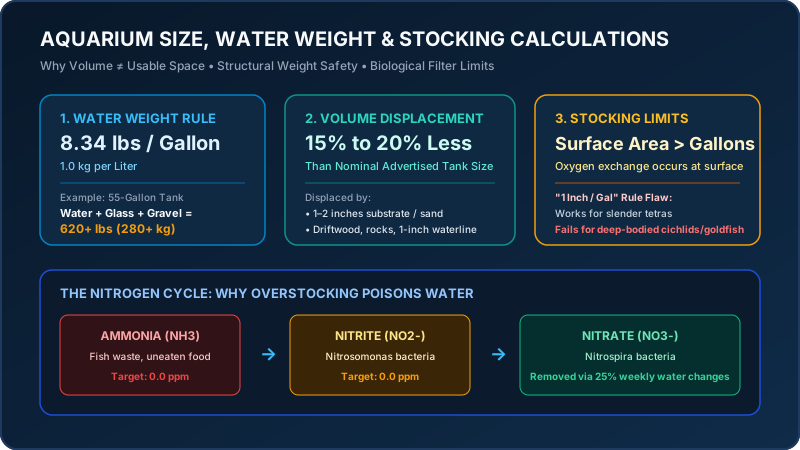
- •Water weighs 1.0 kg per liter (8.34 pounds per US gallon); a filled 208 L (55-gallon) aquarium with glass and gravel weighs over 280 kg (620 lbs).
- •Nominal tank dimensions overestimate true usable water volume by 15% to 20% due to substrate displacement and top waterline margins.
- •The traditional "one inch of fish per gallon" rule is biologically flawed and only applies to slender, low-waste community fish like neon tetras.
- •Surface area determines oxygen exchange far more than vertical tank height; long, shallow tanks hold healthier bio-loads than tall hex tanks.
- •The biological nitrogen cycle requires 4 to 6 weeks to establish beneficial Nitrosomonas and Nitrospira bacteria before full stocking.
Setting up a new fish tank is one of the most rewarding aquatic hobbies, but beginner aquarists frequently encounter two major unexpected challenges: calculating actual structural floor weight and understanding biological stocking limits.
A 208 L (55-gallon) glass tank does not weigh 55 pounds — with substrate, rocks, water, and glass, it exerts over 280 kg (600 lbs) of downward pressure on your home floor. Furthermore, stocking fish based on outdated rules often leads to toxic ammonia spikes. This guide breaks down the physical math of water weight and the biological limits of aquatic stocking.
1. The Water Weight Formula & Structural Safety
Freshwater weighs 1.0 kilogram per liter (8.34 pounds per US gallon). Saltwater is slightly denser at 1.025 kg/L (8.55 lbs/gal) due to dissolved salts.
When calculating the total structural load an aquarium stand and floor joists must support, you must account for three distinct weight components:
Or in US customary units:
Weight Reference Table for Standard Aquariums:
| Standard Tank Size | Dimensions (cm / inches) | Empty Glass Weight | Filled Water Weight | Total Floor Weight (with Gravel) |
|---|---|---|---|---|
| 38 L (10 Gallon) | 51 × 25 × 30 cm (20" × 10" × 12") | 5.0 kg (11 lbs) | 37.6 kg (83 lbs) | 50 kg (110 lbs) |
| 75 L (20 Gallon Long) | 76 × 30 × 30 cm (30" × 12" × 12") | 11.3 kg (25 lbs) | 75.7 kg (167 lbs) | 102 kg (225 lbs) |
| 110 L (29 Gallon) | 76 × 30 × 46 cm (30" × 12" × 18") | 18.1 kg (40 lbs) | 109.8 kg (242 lbs) | 150 kg (330 lbs) |
| 208 L (55 Gallon) | 122 × 33 × 53 cm (48" × 13" × 21") | 35.4 kg (78 lbs) | 208.2 kg (459 lbs) | 283 kg (625 lbs) |
| 284 L (75 Gallon) | 122 × 46 × 53 cm (48" × 18" × 21") | 52.2 kg (115 lbs) | 283.5 kg (625 lbs) | 386 kg (850 lbs) |
| 473 L (125 Gallon) | 183 × 46 × 56 cm (72" × 18" × 22") | 93.4 kg (206 lbs) | 473.1 kg (1,043 lbs) | 635+ kg (1,400+ lbs) |
Calculate Custom Tank Volume & Safe Fish Stocking with Our Tool
Calculate accurate, personalized recommendations with our free evidence-based tool.
2. Nominal Volume vs. Usable Water Volume
A brand-new "20-gallon" (75 L) aquarium rarely contains 20 gallons of water:
- •Glass Thickness: Tank external dimensions include the glass walls, which reduces internal volume by 2 to 4 liters (0.5 to 1.0 gallon).
- •Top Waterline Margin: Water is filled 2.5 cm (1 inch) below the plastic rim to prevent fish from jumping out (-6 liters / -1.5 gallons).
- •Substrate Displacement: A standard 5 cm (2-inch) bed of aquarium gravel or aquasoil displaces 6 to 10 liters (1.5 to 2.5 gallons) of water.
- •Hardscape: Large driftwood branches and decorative rocks displace additional volume.
Rule of Thumb: A standard aquarium typically holds 15% to 20% less water than its advertised commercial size. Always calculate medication dosages and water conditioner treatments based on *net* water volume, not the box label.
3. Why the "One Inch of Fish Per Gallon" Rule Is Broken
The ancient rule of "1 inch of fish per 1 gallon of water" is one of the most misleading myths in pet care. It fails because it evaluates length while ignoring three-dimensional body mass (biomass):
- •Mass scales exponentially: A 10-inch Oscar cichlid or adult goldfish does not have the same bioload as ten 1-inch Neon Tetras. In biological mass and waste output, that single 10-inch fish produces 50 to 100 times more waste than 10 small tetras combined.
- •Waste Output (Bioload): Carnivorous and deep-bodied fish require powerful biological filtration and substantially higher water volumes.
- •Territory & Swimming Geometry: A 4-inch active schooling fish (like a Giant Danio) needs a long 4-foot swimming lane, while a 4-inch stationary ambush predator (like a Dwarf Frogfish) requires minimal swimming space.
4. The Biological Nitrogen Cycle in Plain English
Every living fish consumes protein and expels toxic ammonia ($NH_3$) through its gills and waste. In an uncycled tank, ammonia accumulates rapidly, burning delicate gill filaments and suffocating fish within days.
A stable aquarium relies on an invisible colony of beneficial nitrifying bacteria living in the filter media and substrate:
- 1Ammonia ($NH_3$): Highly toxic. Target level: 0.0 ppm.
- 2Nitrosomonas Bacteria: Oxidize toxic ammonia into Nitrite ($NO_2^-$). Nitrite binds to fish hemoglobin, preventing red blood cells from carrying oxygen (brown blood disease). Target level: 0.0 ppm.
- 3Nitrospira Bacteria: Convert nitrite into Nitrate ($NO_3^-$). Nitrate is far less toxic and tolerated up to 20–40 ppm.
- 4Water Changes: Nitrate cannot be broken down by standard aerobic filters. You must perform a 20% to 25% partial water change weekly to physically remove nitrate and replenish mineral hardness.
Check Water Temperatures & Metric Unit Conversions
Calculate accurate, personalized recommendations with our free evidence-based tool.
Reviewed & verified by Dr. Imad Khan, DVM, MSc · Doctor of Veterinary Medicine & Masters in Poultry Science · View editorial credentials →