
How Much Hay Does a Horse Need? Daily Feed & Forage Guide
Calculate exact daily hay rations for your horse by body weight and workload. Learn how many flakes to feed, how to weigh bales, and how to prevent colic and gastric ulcers.
Key Technical Takeaways
- •Healthy adult horses require 1.5% to 2.5% of their body weight in dry forage daily (6.8 to 11.3 kg / 15 to 25 lbs of hay for a 450 kg / 1,000 lb horse).
- •Horses produce stomach acid 24 hours a day and need near-continuous access to forage to buffer acid and prevent gastric ulcers.
- •Always feed hay by weight rather than flake volume: individual flakes from different bales vary widely from 1.4 to 3.2 kg (3 to 7 lbs).
- •In freezing winter temperatures, fermenting fiber acts as an internal heater; increase forage by 15% to 20% for each 10°F drop below freezing.
- •For easy keepers and horses prone to laminitis, select low-sugar grass hay (NSC below 10%) and use slow-feeder hay nets.
A healthy adult horse requires between 1.5% and 2.5% of its total body weight in dry forage every single day. For an average 450 kg (1,000 lb) riding horse, this equals 6.8 to 11.3 kg (15 to 25 lbs) of clean, dry hay daily. Forage is not just an optional component of a horse's diet — it is the foundation of their entire digestive health.
This guide explains how to calculate your horse's exact daily forage needs, how to convert dry weight into barn flakes, how workload and winter temperatures change feed requirements, and how to prevent feed-related colic and gastric ulcers.
1. The Science of Hindgut Fermentation
Horses evolved as continuous grazers (trickle feeders), wandering pastures and nibbling high-fiber grasses for 14 to 18 hours each day. Unlike humans and dogs, whose stomachs produce acid only when food is eaten, a horse's stomach produces acid continuously, 24 hours a day, 7 days a week.
When a horse chews long-stem hay, it produces saliva that acts as a natural antacid. If a horse is left without hay for more than 4 to 6 hours, stomach acid pools against the unprotected lining of the upper stomach, causing painful gastric ulcers in as little as 5 to 7 days.
Furthermore, the horse's large intestine relies on beneficial microbes to ferment fiber into usable energy, supplying up to 70% of the horse's daily maintenance calories.
Or in US customary pounds:
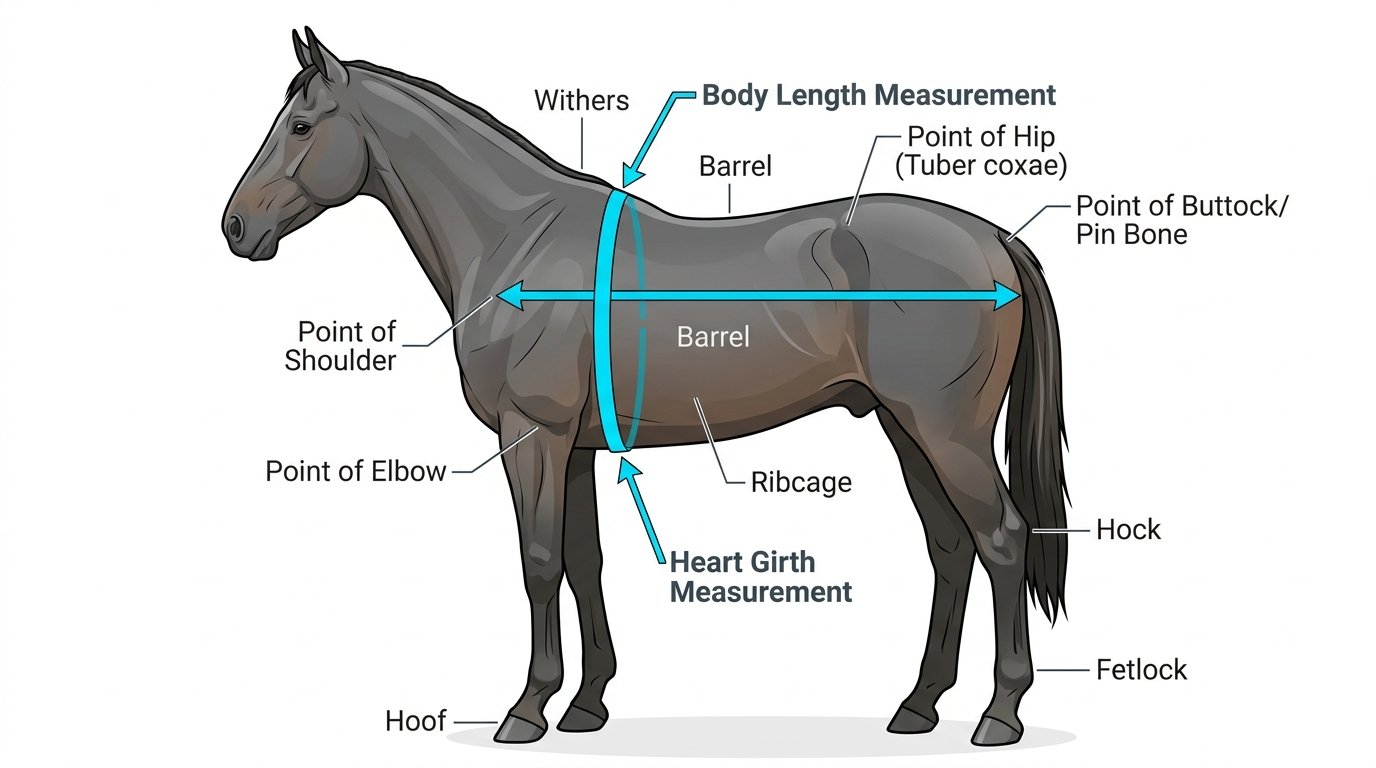
2. Daily Hay Feeding Chart by Weight & Workload
The table below outlines daily hay requirements in both metric kilograms and US pounds, alongside approximate barn flakes (assuming a standard two-string 23 kg / 50 lb square bale yielding 10 to 12 flakes at roughly 2.0 to 2.3 kg / 4.5 to 5.0 lbs per flake):
| Horse Body Weight | Pasture Maintenance (1.5% BW) | Moderate Work (2.0% BW) | Heavy Work / Nursing (2.5% BW) | Daily Flakes |
|---|---|---|---|---|
| 270 kg (600 lbs) (Pony / Small Arab) | 4.1 kg (9.0 lbs) | 5.4 kg (12.0 lbs) | 6.8 kg (15.0 lbs) | 2 to 3 flakes |
| 360 kg (800 lbs) (Large Pony / Yearling) | 5.4 kg (12.0 lbs) | 7.3 kg (16.0 lbs) | 9.1 kg (20.0 lbs) | 3 to 4 flakes |
| 450 kg (1,000 lbs) (Average Quarter Horse / Thoroughbred) | 6.8 kg (15.0 lbs) | 9.1 kg (20.0 lbs) | 11.3 kg (25.0 lbs) | 4 to 5 flakes |
| 545 kg (1,200 lbs) (Warmblood / Large Hunter) | 8.2 kg (18.0 lbs) | 10.9 kg (24.0 lbs) | 13.6 kg (30.0 lbs) | 5 to 6 flakes |
| 635 kg (1,400 lbs) (Draft Cross / Warmblood) | 9.5 kg (21.0 lbs) | 12.7 kg (28.0 lbs) | 15.9 kg (35.0 lbs) | 6 to 7 flakes |
Calculate Exact Forage & Concentrate Rations with Our Feed Calculator
Calculate accurate, personalized recommendations with our free evidence-based tool.
3. Why You Must Weigh Hay, Not Count Flakes
One of the most frequent feeding mistakes in barns is measuring forage by "flakes" alone. A flake is simply a compressed slice created by the baling machine:
- •A flake of leafy, tightly packed alfalfa can weigh 2.7 to 3.6 kg (6 to 8 lbs).
- •A fluffy, coarse flake of grass hay from the same size bale may weigh only 1.1 to 1.6 kg (2.5 to 3.5 lbs).
Feeding "two flakes morning and night" could mean you are feeding 4.5 kg (10 lbs) of hay one month, and 10.9 kg (24 lbs) the next month.
How to Weigh Hay in 30 Seconds with a Hanging Scale
- 1Buy an inexpensive digital hanging luggage or fish scale.
- 2Hang an empty mesh hay net on the scale hook and press Tare (zero).
- 3Stuff the desired morning or evening hay flakes into the net and lift.
- 4Check the weight and adjust until it matches your horse's target portion.
4. Workload, Cold Weather & Seasonal Adjustments
A horse's caloric needs fluctuate based on environment and physical exertion:
Cold Weather Winter Adjustment
Digesting fiber produces tremendous internal heat through gut fermentation — far more heat than digesting grains or sweet feed. In winter, hay is a horse's internal furnace.
- •The Rule of Thumb: For every 5°C (10°F) drop below your horse's lower critical temperature (-1°C / 30°F for a horse with a full winter coat), increase daily hay by 15% to 20% (approximately 0.9 to 1.8 kg / 2 to 4 extra pounds of hay per day).
Workload Categories
- •Maintenance (Pasture pets, non-ridden horses): 1.5% to 1.75% of body weight in good-quality grass hay + clean water + a balanced mineral salt block. Concentrated grain is rarely needed.
- •Light Work (1 to 3 hours of trail riding, pleasure riding per week): 1.8% to 2.0% of body weight in hay + vitamin/mineral balancer.
- •Moderate to Heavy Work (Rodeo, eventing, daily lessons): 2.0% to 2.5% of body weight in forage, supplemented with balanced concentrates divided into 2 to 3 small daily meals.
5. Easy Keepers vs. Hard Keepers
Not all horses utilize calories the same way:
Managing the "Easy Keeper" (Metabolic Breeds)
Breeds such as Morgans, Fjords, Haflingers, and ponies gain weight rapidly on minimal forage, making them vulnerable to metabolic issues and laminitis (founder).
- •Never starve an easy keeper: Cutting forage below 1.5% BW causes ulcers and liver complications.
- •Use Slow-Feeder Hay Nets: 1-inch to 1.5-inch mesh nets prolong chewing time from 45 minutes to 4 hours, satisfying grazing urges without overloading calories.
- •Soak Hay: Soaking grass hay in cold water for 30 to 60 minutes leaches out simple sugars by 25% to 40% while preserving healthy fiber.
Managing the "Hard Keeper" (Thoroughbreds & Seniors)
Older horses with worn teeth or high-metabolism horses struggle to maintain a healthy body condition score (BCS 5/9).
- •Supplement premium grass hay with 20% to 30% alfalfa (lucerne), which provides 20% to 30% more calories and higher calcium.
- •For senior horses who struggle to chew long-stem hay, substitute soaked hay pellets or chopped forage cubes.
6. Golden Rules of Horse Feeding
- 1Feed frequent, small portions: Divide total daily hay into at least 2 to 3 feedings per day (or use continuous slow-feeders).
- 2Make all feed changes gradually: Transition between hay batches or new feeds over 10 to 14 days to give gut microflora time to adjust and avoid colic.
- 3Always supply abundant fresh water: An adult horse drinks 30 to 45 liters (8 to 12 gallons) of fresh water daily (more in summer or during heavy work). Dehydrated horses rapidly develop impaction colic.
Estimate Your Horse's Weight Accurately with Our Weight Calculator
Calculate accurate, personalized recommendations with our free evidence-based tool.
Reviewed & verified by Dr. Imad Khan, DVM, MSc · Doctor of Veterinary Medicine & Masters in Poultry Science · View editorial credentials →