
How Big Will My Puppy Get? The Complete Growth Chart & Weight Guide
A comprehensive veterinary guide explaining how puppies grow, how to predict adult size from current weight, and when different dog breeds reach adult maturity.
Key Technical Takeaways
- •Medium and large breed puppies typically weigh roughly 50% of their adult weight at 16 weeks (4 months) of age.
- •Toy and small breeds (<25 lbs) finish growing between 9 and 12 months, while giant breeds continue filling out until 24 months.
- •Growth velocity follows a non-linear S-curve: peak daily gain occurs between 10 and 20 weeks before plateauing.
- •Overfeeding puppies does not increase adult height—it accelerates skeletal growth dangerously, causing developmental orthopedic disease.
When you bring home a bouncy, clumsy new puppy, one of the first questions on your mind is: *"How big will my puppy get?"* Whether you have adopted a mixed-breed rescue from a shelter or welcomed a purebred puppy into your home, knowing their projected adult size is essential for choosing the right food, purchasing appropriately sized crates and beds, and planning for adult exercise and preventive medication costs.
Canine pediatric science relies on validated growth curves developed by the National Research Council (NRC) and veterinary nutrition researchers. Unlike human children, whose growth spans nearly two decades, puppies compress their entire skeletal development into just 9 to 24 months, depending on their breed size.
You can calculate your puppy's exact projected adult weight range using our interactive Puppy Weight & Adult Dog Size Predictor.
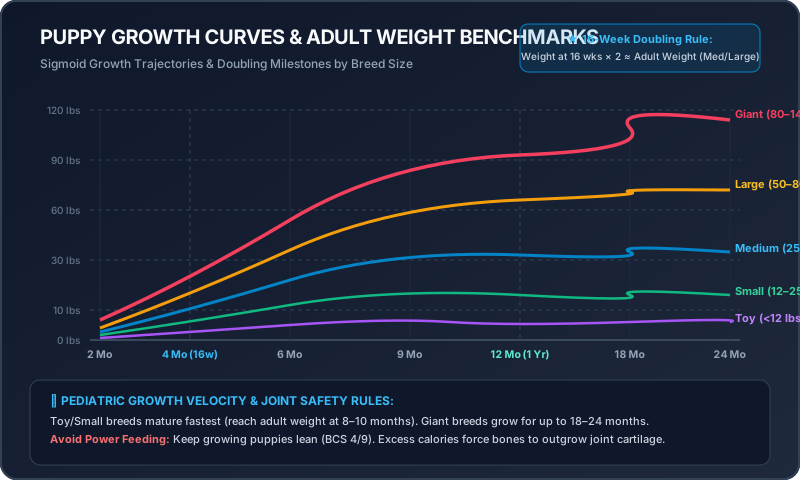
1. Puppy Growth Milestones by Breed Size Class
The most critical factor governing when your puppy stops growing is their adult breed size category. Small dogs mature rapidly, while giant dogs have prolonged skeletal growth:
| Breed Size Class | Adult Weight Range | 16-Week Weight (% Adult) | Growth Plates Close | Full Adult Maturity Age | Example Breeds |
|---|---|---|---|---|---|
| Toy Breed | Under 12 lbs (<5.5 kg) | ~65% to 75% | 8 to 10 months | 9 to 12 months | Chihuahua, Yorkie, Pomeranian, Maltese |
| Small Breed | 12 to 25 lbs (5.5–11.5 kg) | ~60% to 65% | 10 to 12 months | 10 to 12 months | French Bulldog, Beagle, Boston Terrier, Dachshund |
| Medium Breed | 26 to 55 lbs (12–25 kg) | ~45% to 50% | 12 to 14 months | 12 to 14 months | Australian Shepherd, Border Collie, Cocker Spaniel, Corgi |
| Large Breed | 56 to 90 lbs (25–41 kg) | ~40% to 45% | 14 to 16 months | 15 to 18 months | Golden Retriever, Labrador, German Shepherd, Boxer |
| Giant Breed | Over 90 lbs (>41 kg) | ~30% to 35% | 18 to 20 months | 18 to 24 months | Great Dane, Mastiff, Saint Bernard, Newfoundland |
2. The Golden Rules of Thumb for Predicting Puppy Weight
If you want a quick mental calculation before using a precision growth curve tool, veterinarians commonly use two validated rules of thumb based on age:
The 16-Week (4-Month) Doubling Rule for Medium and Large Breeds
For medium and large dogs (expected adult weight between 30 and 80 lbs), your puppy's weight at 16 weeks of age is almost exactly half (50%) of their adult weight.
>
The 6-Week & 12-Week Rules for Toy and Small Breeds
Because tiny dogs achieve maturity much faster than large breeds, the doubling rule shifts earlier:
- •At 6 Weeks Old: Multiply current weight by 4 to predict adult weight.
- •At 12 Weeks Old: Multiply current weight by 2 (and add 1 to 2 lbs for small terriers).
*Example:* A Chihuahua puppy weighing 1.2 lbs at 6 weeks: $1.2 \times 4 = \mathbf{4.8 \text{ lbs adult weight}}$.
3. Physical Clues: How to Assess a Mixed-Breed Rescue Puppy
If you adopted a rescue puppy with unknown parentage, simple math isn't the only tool at your disposal. Veterinarians and shelter technicians evaluate three physical hallmarks:
1. Paw Size Relative to Leg Length and Hock Joints
Puppy paws grow faster than the rest of their body. If a 12-week-old puppy has oversized, heavy paws with prominent, knobby "wrist" joints (the carpal and tarsal growth plates), their frame is built to support a much larger adult skeleton. Conversely, if their paws are slender and dainty in proportion to their legs, they will likely remain in the small-to-medium size range.
2. Loose Skin Around the Scruff and Shoulders
Puppies grow into their skin! Pick up the loose skin along the scruff and shoulders. If there is substantial excess, velvety loose skin with plenty of slack, the puppy still has significant muscular and skeletal expansion ahead. If the skin is taut and fits closely against the body, the puppy is closer to their mature frame.
3. Teeth Eruption Timeline
To predict adult weight accurately, you must know your puppy's exact age in weeks. You can pinpoint age by examining their teeth:
- •3 to 5 Weeks: Deciduous (baby) needle teeth erupt (incisors and canines).
- •6 to 8 Weeks: Full set of 28 sharp baby teeth are present.
- •12 to 16 Weeks: Baby incisors fall out and are replaced by blunt permanent adult incisors.
- •16 to 24 Weeks: Adult canines erupt; molars appear at the back of the jaw.
- •6 Months: Complete set of 42 adult teeth are fully present.
4. Understanding the Non-Linear Sigmoid Growth Curve
Puppies do not gain weight in a steady diagonal line. Their growth velocity follows an S-shaped (sigmoid) biological curve:
- 1The Lag Phase (Weeks 0 to 8): Nursing puppies gain steadily, gaining 5% to 10% of their birth weight daily, but total volume remains small.
- 2The Exponential Growth Surge (Weeks 8 to 20): This is the rapid growth phase where puppies seemingly double in size overnight. Daily caloric requirements are highest relative to body weight (up to 3× adult resting calories).
- 3The Inflection Point (Weeks 20 to 28): Daily weight gain noticeably decelerates. Puppies begin shifting energy from bone lengthening to muscle development.
- 4The Plateau Phase (Month 9 onwards): Long bones finish calcifying, growth plates seal, and puppies reach their final skeletal height. Giant breeds spend an additional 6 to 12 months simply filling out chest width and muscle mass.
5. Pediatric Nutrition: The Danger of "Power Feeding"
A dangerous myth among some puppy parents—especially owners of Rottweilers, German Shepherds, and Mastiffs—is that feeding extra food will produce a "bigger, more impressive adult dog."
This is scientifically false and clinically harmful.
A dog's final adult height and skeletal frame size are strictly determined by genetics, not calorie consumption:
- •Overfeeding Accelerates Growth Rate, Not Final Size: Feeding excess calories forces bones to lengthen before the cartilage has adequately mineralized, causing catastrophic developmental orthopedic diseases, including:
- •Canine Hip Dysplasia (CHD)
- •Elbow Dysplasia
- •Osteochondritis Dissecans (OCD)
- •Hypertrophic Osteodystrophy (HOD)
- •Calcium and Phosphorus Balance: Large breed puppies require specialized large-breed growth formulations with tightly controlled calcium levels (0.8% to 1.2% dry matter) and balanced calcium-to-phosphorus ratios (1.1:1 to 1.4:1).
Keep your puppy at a lean Body Condition Score (BCS) of 4 out of 9—where ribs are easily felt under a light layer of skin—to give their joints the healthiest possible foundation for a long, active life.
Calculate Your Puppy's Exact Daily Food & Portion Amounts
Calculate accurate, personalized recommendations with our free evidence-based tool.